RO or thermal? Desalination selection in Gulf conditions
Gulf seawater is hot, saline and biologically active. The textbook case for membranes weakens here — but it does not collapse. A selection method, with numbers.
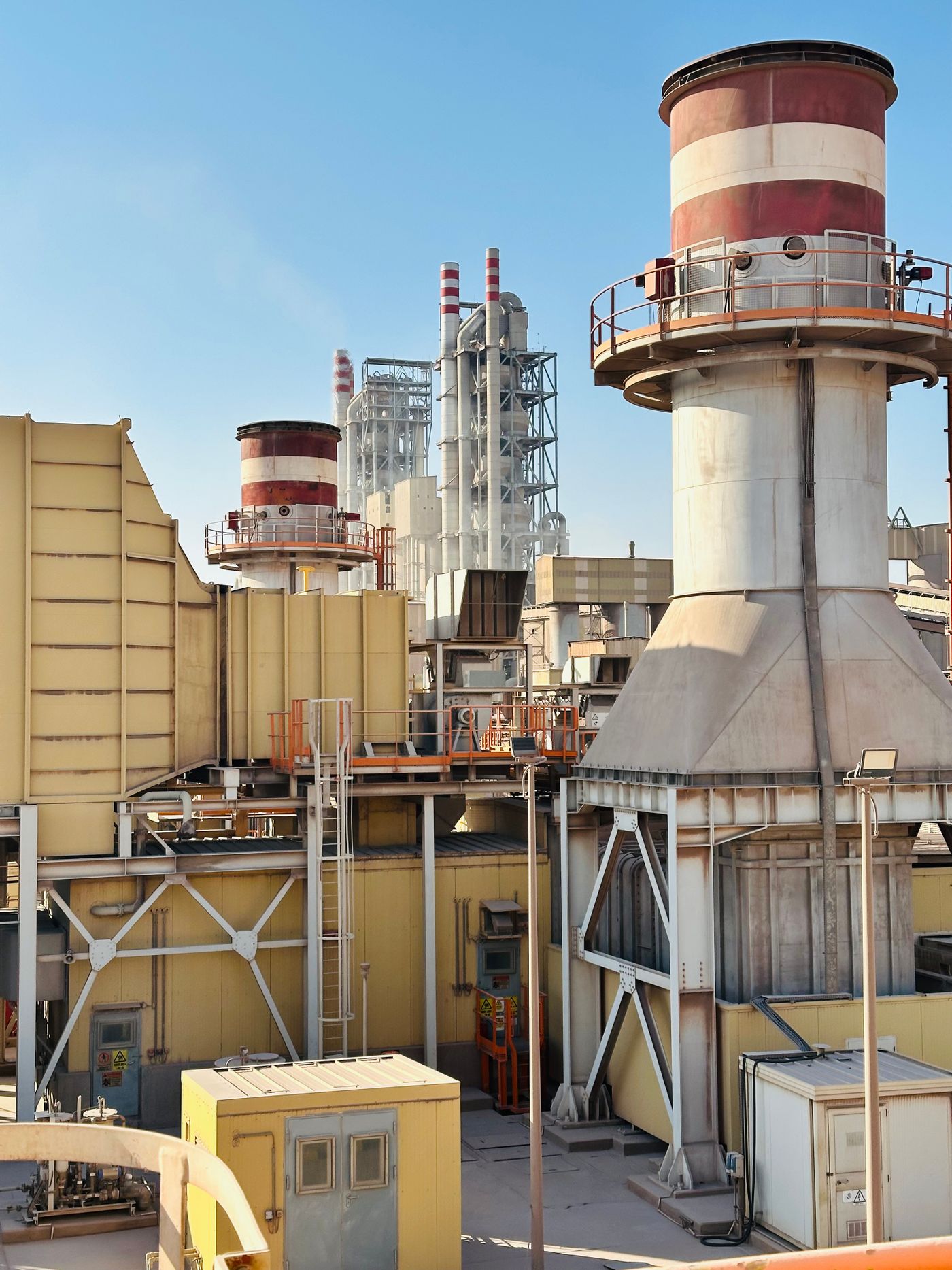
Ask a membrane supplier and the answer is reverse osmosis. Ask an EPC contractor with a thermal yard and the answer is MED. Both will produce a levelised cost of water that proves it. The selection question deserves better than duelling spreadsheets, because the plant will run for twenty-five years in water that is unlike the water in the textbook.
This article sets out the comparison I use when asked to review a process selection for new or expanded capacity on the Gulf coast. It is written for the engineer or reviewer who must defend the choice, not for the vendor who must win it.
The feedwater is the project
Open-ocean seawater is around 35 g/L total dissolved solids at 15–25 °C. The Gulf is a shallow, semi-enclosed basin with restricted exchange through the Strait of Hormuz and evaporation far exceeding inflow. Design feedwater on the Qatari coast is typically 42–47 g/L TDS, with surface temperatures from about 18 °C in January to 35 °C or more in August.1
Salinity raises the osmotic pressure a membrane must overcome; temperature raises membrane salt passage and accelerates biological activity. The basin also carries real biological risk: harmful algal blooms have forced extended shutdowns of coastal plants, and jellyfish ingress is a recurring intake problem. None of this appears in a levelised cost model unless you put it there.2
What thermal still does well
Multi-stage flash carried the Gulf for forty years for a reason: it is nearly indifferent to feed salinity and biology. Evaporation does not care what the osmotic pressure is, coarse pretreatment suffices, and product purity of under 25 mg/L TDS comes out regardless of feed quality. MSF plants co-located with power stations routinely run at availabilities above 94 per cent, and the operating experience in the region is measured in plant-centuries.
Multiple-effect distillation with thermal vapour compression improved on MSF’s economics: gained output ratios of 10–14 against 8–10, lower top brine temperatures around 65 °C that ease scaling, and less pumping. Where a steam host exists — a power plant, a refinery, industrial waste heat — thermal desalination converts low-grade heat that may otherwise be rejected.
The membrane case
Seawater RO takes no steam and, with isobaric energy recovery, needs roughly 3.0–4.5 kWh of electricity per cubic metre in Gulf conditions. That is the whole energy bill. It scales in smaller increments, builds faster, and decouples water production from power plant despatch — which matters as grids add solar capacity and the steam host’s economics shift under it.3
The penalties are at the front end. At 45 g/L and 35 °C, permeate salt passage rises and boron passage rises with it, often forcing a partial second pass. Warm, nutrient-rich water makes biofouling a certainty rather than a risk, so pretreatment is not a sand filter: dissolved air flotation ahead of ultrafiltration or dual-media filtration is now the defensible baseline, sized for bloom conditions rather than average ones.
Comparing energy honestly
Most bad selections trace to one accounting error: comparing thermal energy and electrical energy as if a kilowatt-hour of 70 °C steam were worth a kilowatt-hour of electricity. It is not. Steam extracted for an MED plant could have made electricity in the turbine; the honest charge is the electricity forgone, which depends on extraction conditions.
Equivalent work: electrical energy plus thermal energy weighted by the electricity the extracted steam would otherwise have generated (ηₑx ≈ 0.08–0.12 for typical extraction).
| Process | Electrical, kWh/m³ | Thermal, kWh/m³ | Equivalent work, kWh/m³ |
|---|---|---|---|
| MSF | 2.5–4.0 | 55–80 | 9–14 |
| MED-TVC | 1.5–2.5 | 40–65 | 6–10 |
| SWRO (with ERD) | 3.0–4.5 | — | 3.0–4.5 |
On equivalent work, membranes win by a factor of two or more, and the gap has widened with every generation of energy recovery device. The theoretical minimum for 45 g/L water is about 1.35 kWh/m³ at 50 per cent recovery, so SWRO now runs within a factor of three of the thermodynamic floor. Thermal processes cannot close that distance; their case must rest elsewhere.4
Availability, fouling and the cost of a bad month
A desalination plant is bought on the cost per cubic metre and judged on the days it could not make water.
The elsewhere is resilience. During severe bloom events, membrane plants in the region have curtailed or stopped while adjacent thermal plants ran on. That risk is manageable — deep intakes, DAF sized for bloom solids, standby cartridge capacity — but each measure is capital, and it should be priced into the RO column rather than discovered in operation.
Availability comparisons should use delivered water over contract years, not nameplate. A fair Gulf assumption is 94–97 per cent for a well-run plant of either kind; the tails differ. Thermal plants lose availability in planned, predictable ways — tube bundle maintenance, cleaning cycles. Membrane plants lose it in weather: a bloom is a regional event, and it arrives when the grid is also at summer peak.
A selection method
The comparison that stands up to review runs in this order:
- Characterise the feed at the intake location across seasons — TDS, temperature, organics, bloom history — before any process work. Two shortlisted sites can differ more than two processes.
- Fix the energy accounting: equivalent work for thermal options, metered electricity for RO, both priced at the project’s marginal energy source, not the tariff.
- Price the pretreatment for the worst credible feed month, not the average. If the RO column does not include bloom-rated DAF, it is not an RO price.
- Test availability with the offtaker’s penalty regime. A water purchase agreement with steep shortfall penalties shifts the answer toward thermal or toward hybrid storage.
- Check the steam host’s remaining life. An MED plant outliving its power station becomes a boiler project nobody priced.
Run this way, most new Gulf capacity selects SWRO, which is what the market has concluded: the large recent procurements in the region are membrane plants. But the method matters, because the exceptions are real — industrial sites with committed waste heat, brine concentrators, and offtakers whose penalty regimes price a lost summer week above a decade of energy savings.
Where this leaves new capacity
Hybrids deserve a closing word. Pairing RO with an existing thermal asset hedges both risks: membranes carry the base load at low energy cost; the thermal plant covers bloom events and peak demand. Several Gulf utilities now operate exactly this portfolio at site level. For a reviewer, the question is no longer “which process is best” but “what mix of energy cost, feed risk and contract penalty is this buyer actually exposed to” — and the feedwater data, not the vendor model, is where the answer starts.
- Lienhard, J. H. et al., Thermodynamic analysis of desalination processes — least work of separation. MIT Abdul Latif Jameel Water & Food Systems Lab.
- International Desalination Association, IDA Water Security Handbook (recent edition): regional capacity and procurement data.
- Voutchkov, N., Desalination Engineering: Planning and Design. McGraw-Hill.
- Missimer, T. & Maliva, R., Environmental issues in seawater reverse osmosis desalination: intakes and outfalls. Desalination 434.
- Author’s project and review records, Qatar and wider Gulf, 2002–2026.
Kassem, M. S. (2026). ‘RO or thermal? Desalination selection in Gulf conditions’. dr-kassem.com/writing/ro-or-thermal-gulf. Accessed 18 Sep 2026.