Heat below 120 °C: the economics of low-temperature recovery
Treatment works reject heat all day — from blowers, engines and the effluent itself. Most of it is too cool to be obviously useful. What the second law allows, and what actually pays.
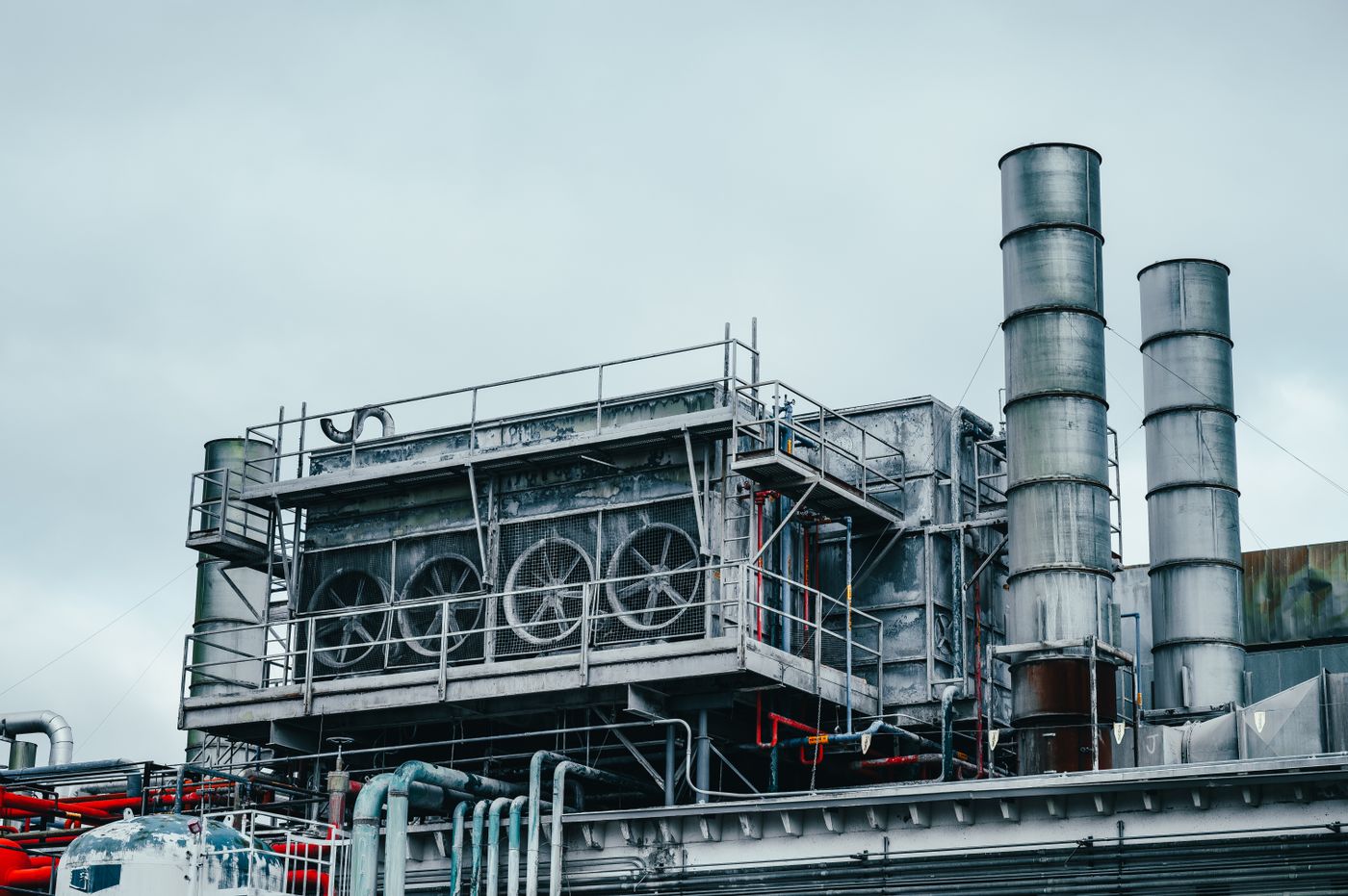
Every treatment works is a heat rejection machine. Aeration blowers dump compression heat, CHP engines reject half their fuel input through jackets and exhaust, and the effluent itself leaves carrying whatever warmth the sewer gave it. Site walk-rounds produce enthusiastic lists of these sources. Most of the list is below 120 °C, and most of the enthusiasm does not survive the second law.
The exergy problem
Heat is only worth what work it can do, and work potential collapses as source temperature approaches ambient. The ceiling is the Carnot factor:
Absolute temperatures. A 90 °C source against a 35 °C Gulf ambient gives ηₘₐₓ = 0.15 before a single real-world loss.
Real organic Rankine cycle machines achieve perhaps half of Carnot at these temperatures, so a 90 °C stream converts to electricity at 6–8 per cent. A megawatt of recovered heat becomes 70 kW of power — and in the Gulf the problem is harsher still, because the cold sink is 35 °C air or 33 °C seawater for half the year. The same machine that returns 12 per cent in a European winter returns half that in a Doha summer.
| Source | Temperature | Sensible route |
|---|---|---|
| CHP exhaust | 350–450 °C | Steam or ORC — the one genuinely premium stream |
| CHP jacket water | 85–95 °C | Digester heating first; ORC only after that demand is met |
| Blower discharge | 60–90 °C | Sludge pre-heating, space or DHW duty |
| Final effluent | 20–30 °C | Heat pump source or district cooling sink |
Find the sink, not the source
The projects that pay do not convert heat to electricity; they displace heat that someone was buying. Digester heating is the canonical case: jacket water at 90 °C matched against a 38 °C mesophilic demand is a perfect fit, and every kilowatt-hour displaced is worth the gas price, not the ORC’s 7 per cent of the power price. The audit question is therefore not “what heat do we reject” but “what heat do we buy, and at what temperature”.
In the Gulf the interesting sink is cooling. Absorption chillers run on 85–95 °C water, and district cooling demand peaks exactly when the plant’s own machinery is hottest. Effluent is equally valuable on the other side of the cycle: at 25–30 °C it is a far better condenser sink than 45 °C summer air, and a heat pump or chiller condensing against effluent gains whole points of COP. A works next to a district cooling plant should be trading water and heat both ways.
Screening rules
- Below 60 °C, electricity generation is off the table; think heat pump source or condenser sink.
- 60–120 °C: match against on-site thermal demand first (digesters, sludge drying, DHW); ORC only for what remains, and only above roughly 500 kW thermal, continuous.
- Price displaced energy at what it displaces — gas for heat, electricity for cooling — and derate ORC output for summer sink temperatures before, not after, the business case.
- Intermittent sources rarely pay: recovery plant is capital that must run. A blower that cycles is a poor host.
Part 2 turns to the source that produces energy rather than merely rejecting it: the digester, and what biogas is actually worth once sized honestly.
- DiPippo, R., Ideal thermal efficiency for geothermal binary plants — the half-Carnot observation. Geothermics 36.
- US DOE, Waste Heat Recovery: Technology and Opportunities in U.S. Industry.
- Author’s screening studies, Qatar industrial and utility sites, 2015–2026.
Kassem, M. S. (2026). ‘Heat below 120 °C: the economics of low-temperature recovery’. Energy at the works, part 1. dr-kassem.com/writing/heat-below-120. Accessed 18 Sep 2026.